
Vet Clinic FAQs
Here you can find all of our most frequently asked questions about our vet clinics and services
On this page we aim to provide answers to a range of your most common enquiries about using our veterinary services. If you can’t find the answer to your query please do give us a call.
NEUTERING POLICY: There are thousands of stray and unwanted cats and dogs in the UK without homes to go to, simply because too many people allow their pets to have a litter of puppies or kittens. The Celia Hammond Animal Trust is a charity.
Our main objective is to humanely reduce the population of dogs and cats, both pedigree and mongrel, in the UK, by neutering. To qualify for treatment at our clinics your pet must be neutered or going to be neutered as soon as possible.
We are very happy to discuss neutering and the benefits of neutering your pet with you, and also have a range of information leaflets available at our clinics. Further information is also available on our website – Please see our Neutering information below.
Am I eligible to use The Celia Hammond Animal Trust's veterinary clinics?
Our low cost veterinary services are available to pets belonging to owners who cannot afford private veterinary fees. This includes owners on benefits, a low income, working part time, students and pensioners.
If you are unable to afford private veterinary fees please contact us to discuss your situation.
Our services are constantly in great demand and our clinics are very busy, so we do ask that if you can afford to use a private veterinary practice that you please do so – in order that our services are available for animals that rely on our help.
We do also recommend that where possible pet owners take out pet insurance so that their pets can receive treatment at a private vet in future. If you are in receipt of certain state benefits you may be eligible to obtain treatment for your pet at another London animal charity hospital – PDSA or Blue Cross.
If you are eligible for treatment at one of the above hospitals we will advise that you contact them first. We do not have a catchment area but we will consider the health of your animal and how long your journey to reach us will be when advising you whether our clinic is the best option for your pet.
What services do you provide?
Our veterinary clinics are fully equipped to provide a wide range of treatments and surgical procedures. Each clinic has X-Ray facilities, endoscopes, ultrasound scanners, and haematology/ biochemistry machines, allowing us to run blood tests immediately. One of our vets is experienced with fracture repairs (orthopaedic surgery)
Do I need to book an appointment?
CONSULTATIONS
If your pet is unwell and needs to see a vet, please call us to make an appointment. Our receptionist will ask what symptoms your pet has to decide how soon your pet needs to be seen. We have emergency as well as routine appointments available.
SURGERY
If your pet requires routine surgery – for example, neutering – you will need to make an appointment. Please phone whichever clinic is closest to you to book an appointment. For their own safety cats must be in a secure cat carrying basket at all times.
What are your opening hours?
Our usual opening hours are Monday to Friday 9am – 5.30pm.
Do you have an emergency out of hours service?
Unfortunately due to the current national shortage of vets we are currently unable to provide our own emergency out of hours service. In an emergency outside of normal hours please phone us and listen to the answer machine message for instructions. – Lewisham (020 8691 2100) or Canning Town (020 7474 8811).
What are your charges?
CHAT is a small charity and we do have to try and recover as much of our costs as possible in order to keep our services running. Our veterinary services are low cost compared to that which you would expect to pay at a private veterinary practice. However our services are not free, nor is it a case of making a donation towards the cost. If you genuinely cannot pay even our reduced fees we will try to help you in some other way.
Please visit our Treatment Prices page on our website
At what age should I neuter my kitten?
Cats breed very rapidly – how many times do we hear someone tell us that their cat got pregnant before they had a chance to neuter her. Female kittens are able to become pregnant at just 4 months old. The Celia Hammond Animal Trust, along with other animal charities such as Cats Protection and the RSPCA, recommend neutering by 4 months old to protect against accidental pregnancy. We routinely neuter our kittens that we rescue and rehome and feral kittens at 9-10 weeks old.
You should plan to neuter your kitten by 4 months of age.
For more information about the benefits of neutering, please see our Neutering Info
My cat has recently had kittens, when should I neuter her?
If you have a cat that has given birth, she needs to be neutered when her kittens are 6 weeks old to prevent her becoming pregnant again. Don’t worry if the kittens are still feeding from her, neutering will not affect her milk supply and we neuter from the flank (side) rather than midline (underneath), so it won’t be uncomfortable for her to continue feeding her kittens after she is neutered. When booking your cat’s appointment and upon admission please let us know that that your cat has kittens at home so that we can prioritise her neutering operation so that she will be amongst the first cats able to go home that afternoon.
For more information about the benefits of neutering, please see our Neutering Info
At what age should I neuter my puppy?
For both male and female puppies we generally recommend neutering at 4–6 months old dependent on size and/or breed.
For more information about the benefits of neutering, please see our Neutering Info
My dog has recently had puppies when can I get her neutered?
We advise neutering your dog when her puppies are between 8 and 12 weeks old.
For more information about the benefits of neutering, please see our Neutering Info
Do you neuter and treat other animals, or just cats and dogs?
We can neuter other pet animals including rabbits, guinea pigs, ferrets, chinchillas and rats but do prioritise neutering cats and dogs when we have availability. We can treat most usual pet animals, but don’t have any vets specialising in exotics.
Do you neuter and treat strays?
We neuter and treat stray and feral cats. Please call us for advice before taking any steps to capture cats yourself or before using traps from another source.
Traps used incorrectly can cause more problems than they solve. In conjunction with other charity neutering schemes we can usually neuter stray cats for free – although if you can pay or make a donation it helps funds stretch further!
If you find a stray dog by law you should contact your local Council Animal Warden.
If you wish to look after a stray dog you have found you must notify your local Council Animal Warden that you are caring for the dog and arrange for the dog to be scanned to check for a microchip.
I would like to get my pet microchipped – do I need an appointment?
We provide microchipping for £11. It is the law that all dogs must be microchipped by 8 weeks old.
From the 10th June 2024 cats must be microchipped by 20 weeks old.
My pet has fleas – do I need an appointment?
The flea products that we sell (with the exception of Frontline and Advantage) are prescription products.
Just like when you visit your doctor and are given a prescription to take to the chemist, these products are by law required to be prescribed by a vet. However once your pet has been seen by the vet you can return to us to buy prescription flea treatments over the counter for the next 6 months.
Prescription flea treatments are very effective and when used according to the instructions have a very high level of safety. There are products that you can buy without a prescription in pet shops and supermarkets. However, many of these are reported to be ineffective and there have been serious concerns over the safety of some of these products.
We would always advise you to obtain your flea products from a vet.
Please phone us if you are unsure if your pet needs an appointment. We do not charge a fee for your pet to have a ‘flea check’ but you will need to pay for flea treatment products.
We do also sell single treatments as well as packs containing enough treatments for three, four or six months. Treating your pet fleas may not be sufficient, you may need use an environmental spray in your home as well to control the fleas. Along with all veterinary practices we do sell household fleas spray.
My pet has worms – do I need an appointment?
Sometimes. We sell a variety of worm treatments over the counter as well as some which are included within prescription flea ‘spot on’ preparations – for which your pet will need an appointment or to have seen our vets within the last 6 months.
We usually need to know your pet’s approximate weight, so if it’s for your dog and you don’t know his or her weight it may be an idea to bring them with you to be weighed.
I have just got a new puppy – what vaccinations does he/she need and when?
Puppies need a course of vaccinations ideally at 8 and 12 weeks or 9 and 12 weeks of age.
Some breeds are particularly susceptible to Parvovirus which can kill e.g. Rottweilers. For these ‘black and tan’ breeds we recommend a third vaccination at 16 weeks. If the dog is over 12 weeks it will a need second vaccination 2–5 weeks later.
Vaccinations are to protect against Canine Distemper, Parvovirus, Adenovirus (Hepatitis), Leptospirosis, and Parainfluenza. A booster vaccination is required once a year to maintain levels of protection against these diseases.
Your puppy may also require flea and worm treatments and our vet will advise you about this at the time of vaccination.
Vaccinations for puppies are very important – puppies should not be allowed contact with other dogs or to walk on the pavement until fully vaccinated.
I have just got a new kitten – what vaccinations does he/she need and when?
Kittens should begin their vaccinations at 8 weeks old. A course of vaccinations is two injections 3-4 weeks apart.
There are two types of vaccinations available for cats. The basic vaccination is against feline enteritis and upper respiratory tract disease (cat flu). This vaccination is recommended for all cats. There is an additional vaccination against viral leukemia (FELV). This is recommended for cats that go outdoors or cats that may be mixing with cats that may be FELV positive.
If your cats will be indoors only and will not be mixing with other cats they do not need to be vaccinated against leukemia. A booster vaccination is required once a year to maintain levels of protection against these diseases.
In addition to vaccinations, your kitten may need worming and flea treatment – our vet will discuss and advise you about this at the time of vaccination.
My cat needs to come to your clinic but I don't have a cat carrying basket?
For their own safety cats must always be brought to us in a secure cat carrying basket. There are often dogs in our waiting rooms that may scare your cat and both clinics are situated on busy main roads.
We sell a variety of new cat carrying baskets: Small – £13.50 & Large – £17.50.
We also usually have second-hand baskets priced from £5 and do also loan second-hand baskets for a returnable deposit of £5.
Please pop in to obtain a cat basket prior to your cat’s appointment.
I have no transport, can you help?
We do not have a transport service, but our cat rescue staff and volunteers will collect and return cats for neutering if it is not possible for you to bring your pet to us, and may be able to help with transporting dogs for neutering if there is no other alternative.
In an emergency, if there is no other alternative and a member of our rescue team is available we will try and help with transportation if we can. Our rescue staff and volunteers are extremely busy and unfortunately cannot help with transporting animals for more routine reasons such as vaccinations.
Also, for insurance reasons, they cannot provide transport for owners to accompany animals to or from our clinics.
I can't afford to pay but my pet needs to see a vet?
Our priority is always to ensure that animals that need veterinary care do receive it.
Please contact us as we may be able to refer you to another London animal charity who will accept a donation.
We may be able to obtain funding from elsewhere (particularly for the purpose of neutering).
How do I get to your clinics?
Lewisham Clinic, 233-235, Lewisham Way, London, SE4 1UY
Lewisham Way is the main A20 and runs between Lewisham and New Cross. Our clinic is situated towards the New Cross end. If you are looking on a map the Lewisham Clinic is very close to the junction with Friendly Street SE8. The clinic has a large blue and white sign which says Celia Hammond Animal Trust Veterinary and Neuter Clinic.
BUSES: Lewisham Way is a main bus route, and the following buses regularly pass our clinic: 21, 436, 136 and 321. The bus stop is Lucas Street in either direction.
TRAINS: The overland station of St. Johns is a 5-minute walk from us. Lewisham train station and New Cross train station are both a 10-minute walk.
BY CAR: Lewisham Way is a red route, so do not attempt to park directly outside as you will get a parking ticket. There is a loading bay on the road outside which you can stop in between 10am and 4pm if you are actively unloading.
If you are accompanying someone who can get out and take the animal into the clinic whilst the driver then goes immediately to park this is ok, but do not leave your vehicle unattended here or you risk getting a parking ticket.
There is unrestricted parking in the local side streets on the Brockley side of the clinic and this is where we recommend parking whilst you attend the clinic.
Please do not park on the pavement against the front of our clinic – this area is for use by our rescue vehicles only.
Canning Town Clinic, 151-153, Barking Road, London, E16 4HQ
The Canning Town Clinic is situated on the main A124, not far from the junction with Hermit Road E16. The clinic is situated behind a bus stop and has a large black and white sign which says Celia Hammond Animal Trust Cat and Dog Neuter Clinic.
BUSES: There is a bus stop directly outside the clinic and opposite the clinic. Buses serving this route are 5, 115, 69, 300 and 276.
TRAINS: Canning Town station is a 5 minute walk away from Underground and Docklands Light Railway connections.
BY CAR: There is no parking at the Canning Town Clinic. There is limited short stay parking on the Barking Road and in local side streets.
HOW OFTEN DO I TREAT MY CAT FOR FLEAS?
Spot-ons are the most commonly used product, a liquid that should be applied to the skin on the back of the neck, usually monthly. The product then spreads to all parts of the skin and is absorbed by the flea through skin contact or blood feeding causing it to die. As well as causing constant itching in cats and humans, fleas commonly cause skin allergies in adults and anaemia in young kittens.
It is important to select a flea product from your vet. Also, selecting the product based on your pets current weight, parting the fur to apply it on the skin on the back of the neck only, and not disturbing the area until dry all ensure safety and effectiveness.
HOW OFTEN SHOULD CATS HAVE A ROUTINE VET CHECK?
Once your cat is neutered, chipped and vaccinated, and assuming all seems OK, it’s a good idea to get your cat checked once a year regardless of whether your vaccine schedule is every one or three years.
Areas owners can’t get to, such as the whole mouth, back of the throat, and abdomen, can be checked and felt, in addition to subtle weight loss noted and the heart and lungs checked.
Usually if a problem is picked up before being noticed by the owner it has more chance of responding to treatment.
DO CATS NEED DEWORMING?
Simply, yes, Cats that go outdoors, indoor cats and kittens all get worms. Adults get Roundworms from eating prey like mice and birds, and kittens from the mothers milk.
Adults also get Tapeworm from prey and both adults and kittens by swallowing fleas when grooming. Unless a cat has a huge number of worms, they are not usually seen in faeces. In contrast to flea products, worming products only work when given, they do not continue to kill worms.
However, regular worming makes sure your cat doesn’t get enough worms to affect their health-a cause of diarrhoea, weight loss and blood loss. Ideally kittens from 2 to 6 months should be wormed monthly, and cats over 6 months every 3-4 months.
Just like flea products, ask your vet which wormers on the market are effective, and again make surethe one you choose is appropriate for your cats weight. Most kill both roundworm and tapeworm, and are in tablet form, however if tableting is too stressful for you or your cat, a spot-on equivalent is available.
NEUTERING (SPAYING / CASTRATING) YOUR CAT OR DOG IS THE SINGLE MOST IMPORTANT DECISION YOU CAN MAKE TO PROTECT YOUR OWN PET AND TO IMPROVE THE WELFARE OF THE WIDER CAT AND DOG POPULATION.
The Celia Hammond Animal Trust runs low cost neuter clinics for cats and dogs whose owners are on benefit or low income – visit our Contact Us page for your nearest CHAT clinic.
WHY DO WE WANT TO NEUTER (SPAY) YOUR FEMALE CAT?
Quite simply, there is a cat overpopulation crisis in the UK.
The problem is that there are too many cats being born for the homes available and this means rescue centres are full of unwanted ‘surplus’ cats, abandoned cats and strays on the streets. Thousands of unwanted cats end up being euthanased because noone wants them.
Cats are prolific breeders and can become pregnant at just 4 months old!
Cats usually have 2 or even 3 litters per year. A typical litter is 2-6 kittens. From four months old, the kittens will also begin to breed. Some may end up homeless and breed on the streets forming feral colonies in towns and cities.
If a female cat mates every time she comes into season and all her kittens survive and breed, there could be up to 21,000 extra cats in just seven years.
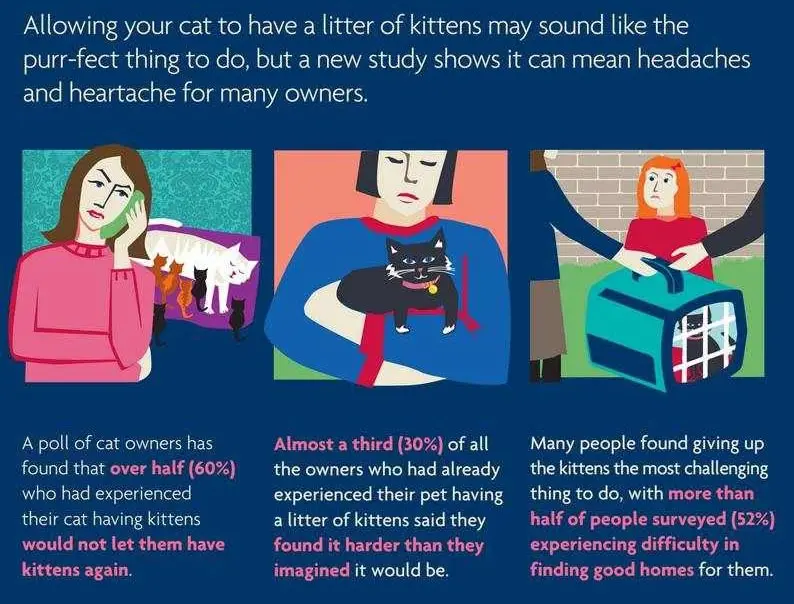
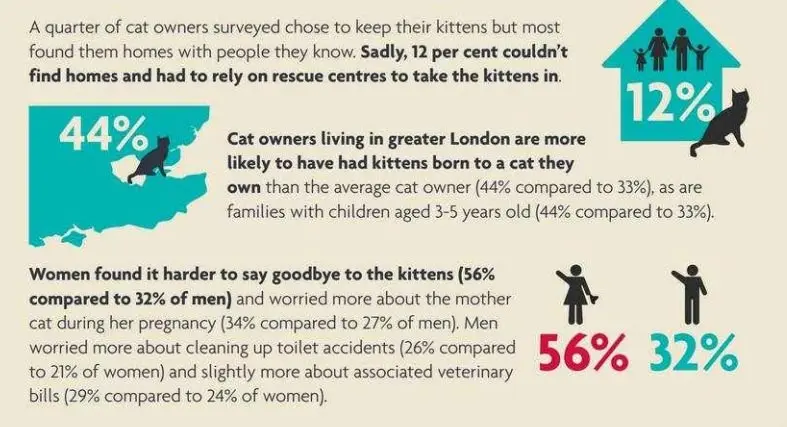
Kittens maybe cute but the reality of letting your cat have a litter is not so rosy as a recent poll of cat owners discovered.
SO WHAT ARE THE BENEFITS OF NEUTERING (SPAYING) FOR YOUR CAT?
Many female cats in season become lost when they are chased by numerous male cats. They often become disorientated and cannot find their way home.
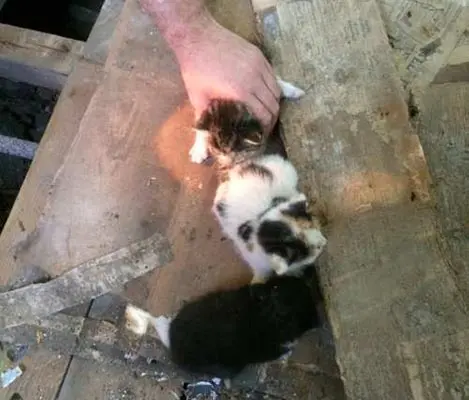
Invariably they become pregnant and have kittens on the streets.
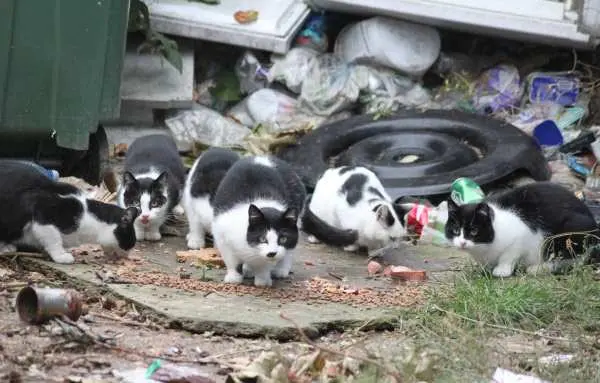
This is how colonies of feral cats are formed. These cats struggle to survive, hungry, often sick or injured.
So many unneutered male cats carry the FIV virus that female cats are at risk if they are bitten during mating. There is no romance between cats when mating. Feline sex can be very violent, particularly when several males are fighting over one female.
FIV and leukaemia virus can be passed to female cats under these circumstances
WHEN SHOULD I NEUTER (SPAY) MY FEMALE CAT?
Female cats should be neutered by 4 months old, but can be neutered at any age afterwards. There is no benefit to your cat in letting her have a litter before she is spayed. If your cat has already had kittens, she should be neutered promptly when her kittens are 6 weeks old or she will become pregnant again. Neutering her will not affect her milk supply.
What about ‘indoor only’ female cats?
It is important that female cats that are kept permanently indoors are also neutered. This is because they will constantly come into season, which is very frustrating for them, and for you! Unneutered female indoor cats are at risk from various health problems including cystic ovaries and pyometra – a potentially fatal infection of the uterus. Undiagnosed, the uterus fills with pus, and then bursts causing peritonitis and death.
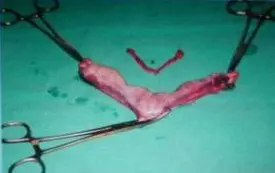
Why do we want to neuter (castrate) your male cat?
Your male cat may not be presenting you with his offspring to find homes for but there are some very good reasons why neutering (castrating him) will protect him from many dangers and give him the best chance of a long and happy life.
To keep your pet from getting lost.
When mature, your unneutered male cat will begin to roam further afield in his search for female cats. As he travels further, he will be at risk when crossing busy roads and from fight injuries acquired during territorial battles with other unneutered male cats. Many male cats roam just a bit too far and cannot find their way home. They then become one of the UK’s 2,500,000 strays that struggle to survive on the streets. A large proportion of cats that are reported to, and taken to, rescue centres are tame unneutered males once owned pets.
To prevent fight injuries
Unneutered male cats are very territorial and aggressive towards other cats. They will be inflicting terrible injuries on other cats, neutered or not! Male cats that have already lost their way home will not have a caring owner to take them to the vet to be treated. Many once loved pets end up in a terrible state with life-threatening injuries. PHOTO : A stray unneutered male cat suffered for weeks with a very nasty infected abscess wound that required weeks of veterinary treatment to enable this wound to heal.

To prevent infection by FIV (Feline Immunodeficiency Virus – the feline equivalent of HIV)
Fighting unneutered male cats are most at risk of contracting FIV. The virus is transmitted between cats through deep bites incurred during fights. FIV is widespread amongst unneutered male cats and can eventually develop into full-blown disease. There is no vaccine against FIV. Neutered cats are much less aggressive to each other, thus by neutering your male cat, he is much less likely to be involved in fights and therefore less likely to contract FIV.
To prevent spraying
Unneutered male cats spray very strong foul-smelling urine to mark their territory. They may spray in and around your home or your neighbours’ homes. Neutering prevents this.
To be a good neighbour
There is an unnaturally high concentration of cats in UK towns and cities. An unneutered male cat will make himself very unpopular spraying and fighting with other cats in the area. A large proportion of reports to animal charities are from people annoyed by unneutered male cats attacking their cats and spraying inside their homes.
To be responsible pet owners
Rescue centres are full of battered, stray, unneutered male cats, some once loved pets that have roamed too far and become stray. Once neutered they soon make lovely pets again, but the numbers needing homes are so great that many are doomed to join the thousands of unwanted cats that are DESTROYED each day in the UK. If only they had been neutered they probably wouldn’t have become strays in the first place. Male cats should be neutered at four months old, but can be neutered at any age. They are never too old.
The Celia Hammond Animal Trust is a member of Catkind – a coalition of charities all working together to promote cat neutering as a humane solution to the problem of there being too many cats and not enough homes available for them. One of the main objectives of Catkind is the promotion of 4 month neutering to reduce the incidences of accidental litters. Kitten Neutering Database (cat-kind.org.uk)
WHY DO WE WANT TO NEUTER (SPAY) YOUR FEMALE DOG?
Rescue Centres all over the UK are full of unwanted mongrel and pedigree dogs and puppies. All are desperately hoping for new homes. Every day, thousands of unwanted healthy dogs and puppies are destroyed simply because there are not enough homes to go around.
OK, so you agree it is irresponsible to breed from your bitch… but why does she need to be spayed?
- Your bitch will be in season for three weeks each time.
- When in season, she will attract unneutered male dogs.
- A male dog will follow a bitch in season everywhere for a chance to mate. You may have to physically fend him off if he is very persistent.
- Wanting to mate, but being unable to do so, will be very frustrating for your unneutered bitch. It is common for bitches to scale high fences, or even dig their way out to find a male dog with whom to mate.
- Many of the dogs that are brought into dog pounds or rescue centres as strays, are in fact bitches in season.
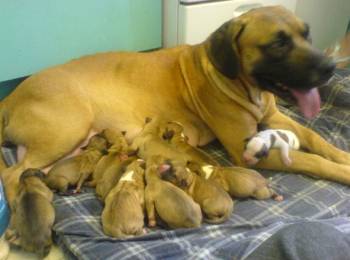
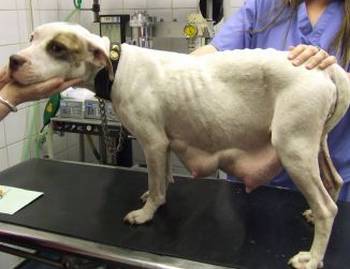
But I’ve paid a lot of money for my bitch. I want her to mate so that I can sell the puppies…?
- Breeding from a bitch is more expensive and far more time consuming than you could possibly imagine.
- Bitches can give birth to up to 10 or more puppies in each litter.
- Whilst pregnant, your bitch will need 2 or 3 times her usual amount of food.
- When the puppies are being weaned, you will need to feed them 4 times per day. You will also have to toilet train them and clear up after them. Can you afford to replace your sofa and carpet?
If you let your bitch have a litter, and manage to home her puppies, you use homes that the thousands of dogs and puppies in rescue centres could have had ~ THEY MAY END UP BEING DESTROYED.
Please be a responsible owner, arrange for your pet to be neutered (spayed) now. Bitches can be neutered at 4-6 months old or any time after. They are never too old.
WHY DO WE WANT TO NEUTER (CASTRATE) YOUR MALE DOG?
Some people think that routine castration of male dogs is unnecessary. Here are some reasons why we think neutering your dog is the best option:
Population control
There are quite simply too many dogs and puppies and not enough homes. Rescue centres and stray dog pounds all over the UK are full of unwanted mongrel and pedigree dogs and puppies, mainly Staffies and Bull breeds. All are desperately hoping for new homes – most will not get them. Don’t let your dog add to the problem by siring even more puppies that nobody wants.
Neuter to reduce roaming
Your male dog can smell a bitch in heat from a very long distance away, and some dogs will do anything to reach her – including scaling tall fences or digging underneath. These dogs are liable to become lost, get into fights with other dogs or be involved in road traffic accidents as they run across busy roads.
- Roaming male dogs may be rounded up by local authority animal wardens. If their owner is not contactable via an ID microchip or ID tag on their collar and if they remain unclaimed after 7 days are at risk of being destroyed.
- Any dog suspected of being a ‘Pit Bull’ type is likely to be seized by the dog wardens or the police if it is not neutered and microchipped.
Neuter to reduce aggression
Often, male dogs become very sexually frustrated. They may try to mount cushions, or even people’s legs and scent mark by urinating around the house. Some become snappy and dominant around people. Most unneutered male dogs are aggressive toward other male dogs often becoming involved in fights during which they can sustain serious or even life threatening injuries.
Medical advantages of neutering
- Many older unneutered male dogs develop prostate enlargement leading to urinary problems, constipation and the possibility of prostatic cancer. The risk of testicular cancer is also completely removed by neutering.
- Neutering is best done when your dog is about six months old, before he has learned any bad habits but it can be done at any age, they are never too old as long as they are healthy.
- Neutering is a straightforward procedure carried out under anaesthetic.
- Your dog will not become fat or lazy due to being neutered. This will only happen if he is over fed or not given enough exercise.
- Neutering does not take away a dog’s ability to be a guard dog. A neutered dog will be just as protective of his territory and family.
Please be a responsible owner and arrange for your dog to be neutered now.
We are sometimes asked - isn't neutering interfering with nature?
By domesticating cats and dogs, humans have already interfered. By breeding cats and dogs and caring for them, we have helped ensure their breeding success and longer life.
The dog and cat population can either be humanely controlled by neutering or left to nature. Nature is cruel, however, and the population will be controlled by starvation and disease since there are no natural predators of the cat or dog in the UK.
The most likely scenario however would be a situation seen by many holidaymakers in some countries – starving colonies of sick animals which are killed by the authorities to contain numbers – a situation most people in this country would find intolerable.
The choice is ours – yours, actually! Please neuter your pet ~ Be part of the solution, not the problem.
