FAQs
Here you can find all of our most frequently asked questions about adopting a cat, neutering, health advice and more
WHAT TO DO WHEN YOU FIND A STRAY CAT?
Firstly we need to try and decide if a cat is actually stray. This is not always that easy to determine and some investigation will be required. Please do contact us, we will ask you some questions and provide you with advice or come and take a look at the cat ourselves.
Initially we will need to make an assessment of the cat’s general physical condition, behaviour and temperament to decide what course of action to take.
Is the cat thin? Is its coat dirty? Does it have wounds or injuries? Does the cat appear disorientated or distressed? Is it approaching numerous people in the street or mewing at various doors and windows? Is it generally hanging around – sleeping under cars or bushes at night? Or at your back door last thing at night and again first thing in the morning? Can you tell the sex of the cat? If female, does the cat appear to be pregnant – or feeding kittens? A pregnant cat’s sides stick out (like a football in her tummy) – a cat who is feeding kittens will hang lower underneath and nipples may be obvious. However, it’s not always that easy to tell, so please contact us asap if you are concerned that a stray cat could be pregnant or possibly feeding kittens.
SHOULD I FEED THE CAT?
If you are at all concerned that a cat is lost or stray then it is best to feed it – offer normal food rather than a tempting treat that any cat would want to eat. Offering food is another good way to get an indication if a cat may be lost – if the cat ravenously consumes the food as though it hasn’t eaten for days then it’s probably lost or stray.
*Advice is often repeated about not feeding potentially stray cats so as not to wrongly feed and encourage an owned cat – however it is better to mistakenly feed an owned cat than allow a cat genuinely in need to suffer.
FEEDING ROUTINE
If we consider that the cat you are concerned about is lost then we will ask you to feed it either to encourage the cat into a feeding routine so that it is easier for us to collect it – e.g. A nervous cat who may require trapping – or simply to ensure that the cat has food and water until we can assist or an owner is located or a more permanent solution is found.
FRIENDLY STRAYS
If a cat has turned up at your home and is friendly and you are able to temporarily care for it whilst seeking its owner then you should:
Ask! Enquire with neighbours if anyone knows who owns the cat.
Check for a microchip! Get the cat scanned for an ID microchip. If you have access to a safe cat carrying basket to transport the cat in your local vet will do this free of charge. Alternatively contact CHAT or your local rescue centre to arrange for a volunteer to visit and scan the cat.
Collar! If the cat is friendly enough make a paper collar with the message “Is this your cat? Please phone…” Put this on the cat for a few days, and if nobody calls you can assume the cat isn’t going to and from its home. (You can use one of our telephone numbers if you prefer – please contact us in advance to discuss this.)
To make the collar use a strip of normal plain paper, place around the cat’s neck and secure the ends with a small piece of sticky tape. Please don’t use strong paper or shiny paper – the collar should easily tear apart if the cat gets caught on anything. Alternatively use a cat safety release collar with the message attached.
Register! Please register the cat as found with your local cat rescue centres and vets.
Details of local animal charities can be found on www.catchat.org
Posters! Put up ‘Found cat’ posters – keep the cat’s description general so that any potential owner has to give more specific details and distinguishing features and/or provide a photo.
PROVIDING THE CAT A HOME
If, having taken reasonable steps to locate the cat’s owner, you decide to give the cat a new home, please arrange a health check for the cat with your local vet and most importantly check that the cat is neutered and microchipped!
If you live close to one of our London veterinary clinics and decide to give a home to a stray we can assist with the initial veterinary care at a minimal cost / donation or free. This includes neutering, microchipping, vaccinations, flea and worm treatment and a general health check for the cat to get you both off to a good start. After this time you will have to take over provision of veterinary care yourself, e.g. pet insurance, private vet, using our subsidised service or if eligible PDSA services.
NERVOUS AND FERAL STRAYS
IMPORTANT: Nervous and feral cats may require capturing (TNR (trap,neuter and return) to be neutered or taken in to be rehomed by CHAT using our specialist equipment. DO NOT try and capture nervous or feral cats yourself using either home-made devices or equipment purchased from the internet or elsewhere. A plan needs to be put in place first as to where any cats that are caught will be going and what will be happening with them. It is especially important that female cats who are feeding unweaned kittens are not caught and separated from their kittens. At CHAT our rescue teams have many years experience and are specialists in humanely working with feral cats – so please contact us to discuss first!
Please feed the cats and watch and observe. If the cat is a lost pet who has become very frightened, by encouraging the cat with food and kindness they should increase in confidence again.
If there are several cats that appear to be living as a group, or particularly if there are adult cats with kittens, then it is likely that the cats are a family of feral cats.
Feral cats are cats that have been born outdoors to stray and abandoned pet cats. Because they have missed out on the early handling and socialisation with humans they grow up nervous of direct contact with humans. They can, if shown kindness, become more confident with people over time and kittens can be successfully tamed and domesticated. Cats breed rapidly so the numbers of cats living in a feral colony can increase rapidly so it is important to promptly seek help to neuter the cats.
Feral cats require food, shelter, veterinary attention if unwell or injured and deserve to be treated kindly just like pet cats.
We will ask you to help by feeding the cats. This may be temporarily until we can take them in or to assist us by attracting the cats to a feeding point or a longer term feeding arrangement if the cats are to be neutered and returned.
Ear tipping: Feral cats that are neutered and returned by CHAT are routinely ‘ear tipped’ – this means that the very top of the left ear is cut flat. This means of identifying feral cats as neutered is used worldwide and enables you to see at a distance if the cat has been neutered. We also ID microchip feral cats at the time of neutering and register them either to ourselves or the feeder if they so wish.
Feral cats are a priority for us at CHAT. Feral cats can suffer great hardship and suffering in their lives. Neutering and taking care of a feral cat colony greatly improves the quality of their lives as well as preventing the births of many more litters.
A healthy colony of neutered feral cats will act as a highly effective rodent patrol, whether in a rural or urban setting.
STRAY AND FERAL CATS WITH KITTENS
From Spring until late Autumn, stray and feral unneutered female cats will be either pregnant or raising a litter of kittens.
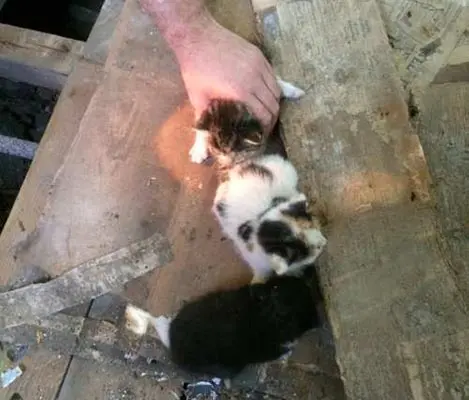
Mother cats usually hide their kittens very well and choose places such as in or under garden sheds, in dense undergrowth, and in or under discarded rubbish such as old furniture. They also like abandoned vehicles, or access cellars, loft spaces or empty buildings through small holes such as broken ventilation grills.
If you discover a cat with a litter of kittens it is best not to disturb them, as there is a risk that the mother cat will feel worried and decide to move her kittens to another hiding place.
Provide mum with some food nearby to reassure her that you mean her and her babies no harm and then contact CHAT for advice and assistance. If you are not local to any of our centres please contact a local rescue organisation.
Details of animal charities all over the UK can be found on www.catchat.org
If the mother cat is friendly towards humans and her kittens are still very young we should be able to collect them and move them to the safety of a foster home or one of our rescue centres.
If the kittens are already mobile – walking and climbing around – unless they are unwanted pet kittens who have just been abandoned, then they will already be very nervous of actual human contact and will require safely capturing using our specialist equipment.
It is vital that we establish how many kittens there are in a litter so as to ensure that none are left behind. Feeding and observing the family for a few days will be required to find out how many kittens there are actually are.
Once in our care, our dedicated staff and volunteers spend time handling, gently playing with and socialising the kittens in order to tame and domesticate them.
BUSY! The Summer months of June, July and August are the height of the kitten season. During these months we are inundated with requests to assist with feral cats and kittens. In some areas, particularly in East London, there is a huge stray and feral cat population.
At this time of year we do our best but can struggle to keep up with the requests for help that keep coming in. We prioritise helping those who are sick or injured or in dangerous locations. We try to catch up with any feral colony neutering that is outstanding in the relatively quieter winter months.
At these busy times if you can provide any additional help, e.g. taking in and temporarily fostering a stray mother cat and her kittens so that the kittens grow up well handled and therefore more homeable, please let us know. We can loan a temporary cage to contain kittens in, and can provide neutering for mum and veterinary treatments such as flea and worm treatments.
CAT BREEDING INFORMATION
Cats are seasonal breeders, typically giving birth to two litters a year (but sometimes three) in Spring and mid – late Summer.
The cat mating season begins in earnest in January and February when unneutered female cats come in to season (“on heat”). They are soon mated by numerous unneutered male cats.
They are pregnant for 9 weeks. A litter of kittens usually contains between 2 and 6 kittens.
Kittens are born with their eyes closed and initially reliant on their mother’s milk. Kittens’ eyes open at around 10 days old. Kittens start to eat solid food between 4 and 6 weeks, but will also continue to be nourished with their mother’s milk during this time.
Mother cats usually come back into season again and therefore can become pregnant again when their kittens are 6 weeks old, BUT some cats come back into season again within 2 weeks of giving birth.
Mother cats give birth to second litters in the summer, and some can give birth a third time in the same year.
Kittens themselves are capable of breeding from 4 months old.
I CAN'T KEEP MY CAT – CAN YOU HELP?
Everyday we receive calls about owned cats which need new homes for a variety of reasons. We do take in pet cats and find them new homes however as much as we would like to be able to help everyone, it just isn’t possible for us to take in every cat that we are asked to help with – it also wouldn’t always be in the best interests of the cat for us to do so.
If possible we will provide advice to help you to continue to care for your cat – this could be behavioural or health care advice or assistance.
Try family, friends, neighbours and work colleagues – you will probably feel happier homing your cat with someone that you know anyway. Advertise for a home via your local vet’s waiting room. Visit any offer of a home and ensure you feel happy and reassured before leaving your cat with them.
Make sure a new owner knows that your cat must be kept completely indoors for the first month before being allowed access to outdoors to ensure that he/she is well settled.
*Never advertise your cat via online sites such as Gumtree or Preloved. You do not know who you are really giving your cat to and they could end up at worst as bait for dog fighting.
If your request is high priority, e.g. imminent eviction, death of owner and no one to care for the cat, we will do our very best to accommodate the cat or alternatively suggest other sources of help.
I CAN'T KEEP MY RESCUED CAT (FROM CHAT OR OTHER) - can you help?
If you originally adopted your cat from CHAT then they must be returned to us or rehomed with our agreement. Adoption agreement condition no.1: “Not to part with possession of the animal(s) except to return it/ them to CHAT by prior arrangement, if for any reason I am unable to keep it/ them. Animals homed together must be returned together unless CHAT agrees otherwise.”
If we are given some notice of the need to rehome the cats, we can attempt to rehome cats directly from you to a new home by advertising them on our website – for many cats this is preferable as an alternative to readmitting them to the centre since it is less stressful and disruptive to the cats.
OTHER RESCUED CATS
If you adopted your cat from another animal charity please contact them first – it is standard practice for animal charities to insist on taking cats back again that they have previously homed.
WHAT CAN I DO IF FIND A CAT INVOLVED IN A ROAD ACCIDENT?
If you find a cat that has been involved in a road accident and is still alive then the priority is to obtain veterinary care asap.
Advice on what to do will differ depending on where you are, what you can put the cat in, if you have transport, how mobile the cat is, etc.
If the cat is still lying in the road you will need to carefully move the cat out of the road to prevent further injury. Try and enlist the help of any passers-by who may be able to knock on any immediate doors to try and locate an owner or obtain more help whilst you stay with the cat.
Your options are:
If you are near a vets then take the cat there. If a passer-by or local resident will assist you then it may be possible to borrow a cat carrying basket from the vets or a neighbouring house to move the cat in. The vets should provide emergency treatment at no cost before passing the cat on to a local animal charity to continue treatment and await hopefully being reunited with an owner.
Phone CHAT, another local animal charity, or the RSPCA (contact details of other local animal charities can be found on www.catchat.org – wait with the cat until help arrives)
WHAT SHOULD I DO ABOUT AN INJURED CAT?
If a cat is injured has wounds or looks unwell please contact your local CHAT centre or your local animal charity. Contact details of other local animal charities can be found on www.catchat.org
In the Summer months particular concern should be paid to cats with wounds, as flies can lay eggs on infected wounds which quickly hatch into maggots. Obtain help immediately in flies are buzzing around a sickly or wounded cat.
AN UNNEUTERED MALE CAT (TOM CAT) KEEPS COMING THROUGH MY CAT'S CAT FLAP, STEALING FOOD AND SPRAYING. WHAT CAN I DO?
A common problem! Although this cat is causing a lot of upset for you and your cat please do feel sorry for him.
He is probably a stray – what typically happens is that someone had him as a kitten but they didn’t get him neutered, as he got older and reached sexual maturity he became less interested in being a homely pet and instead began to roam further afield in search of female cats or to take part in territory battles with other unneutered male cats. Eventually he lost his way and he now has to survive by scavenging and stealing food where he can.
As an unneutered male he will be a worry to, and possibly aggressive to, your own neutered cat and his urine marking will be offensive.
He needs neutering – once neutered his hormones will settle down and he will cease being aggressive towards other cats and will stop spraying.
If he seems to be a stray we can neuter him – we can help capture him if he is nervous and we will then, neuter, microchip, vaccinate, de flea and worm him and treat any ailments.
We will need to discuss with you if you are happy for him to be returned – bear in mind that he will soon become a handsome, well mannered and domesticated cat, and he will require feeding regularly. Alternatively, it may be decided that we need to try to find him a new home.
If there is a possible owner we are happy to approach them (without disclosing who contacted us) to discuss getting him neutered. Unneutered male cats don’t spray in their own homes and his owners will probably be completely unaware of the havoc their cat is causing in the local area. We can arrange free neutering if need be and also assist with transporting him to be neutered if required.
WHY IS MY CAT BEING DIRTY IN MY HOUSE?
Medical reasons
Firstly, it is important to find out or rule out a medical reason, i.e. is your cat unwell? URINE INFECTION: Your cat may have a urine infection (cystitis) which is causing him or her to feel the urge to urinate frequently. Cats with cystitis will squat and attempt to pass or pass a small amount of urine which may be slightly blood tinged. A cat with cystitis may try to do this several times an hour and they often have a preference for soft surfaces such as duvets, sofas, cushions and carpets. Cystitis is very painful and your cat will probably seem uncomfortable and may be quiet, a bit withdrawn or moody. If your cat is showing symptoms of cystitis you should seek veterinary attention as you cat will probably require medication and pain relief. Cystitis can occur as a one off occurrence and once treated your cat will cease urinating inappropriately. If the cystitis continues to recur the cause will need to be investigated and could be caused by the presence of Urinary crystals. URINARY CRYSTALS: Crystals can form in the urine and then irritate the bladder wall and cause inflammation and symptoms of cystitis. Urinary crystals can cause a blockage so that the cat cannot urinate at all – this is an emergency as a total blockage will be fatal if not treated as soon as possible. Partial blockage and long term irritation can be a cause of cats urinating in the wrong places over a longer period of time as opposed to a sudden bout of painful cystitis. Treatment is usually to feed your cat on a special veterinary prescription food to prevent crystals from forming in the cat’s urine. DIABETES: Cats can develop diabetes, symptoms include increased thirst and urination, and this can be exhibited as urinating in the wrong places, e.g. corner or rooms, work tops. A simple glucose test can be carried out either by testing your cat’s urine for traces of glucose or via a blood test. A cat with diabetes requires treatment for his or her condition but once the disease is under control should stop urinating in the wrong places. KIDNEY / RENAL PROBLEMS: Cats with kidney disease drink more and urinate more and may urinate in the wrong place. Any cat with increased thirst and urination needs veterinary attention to check for kidney problems or diabetes.Elderly cats
Frail elderly cats are best provided with an indoor litter tray so that they do not have to struggle to go outside. Elderly animals can have accidents from time to time and a responsible pet owner should be understanding and treat their pet with kindness when this occurs. If you are struggling to cope with an elderly cat being dirty please seek veterinary advice or contact us for support.Defecating
Defecating in the wrong place is less common than inappropriate urinating. If you cat has loose stools or diarrhoea it may simply be a case that they cannot make it to the garden or litter tray in time. If your otherwise healthy adult cat develops an upset stomach, provide a litter tray and feed a bland diet, e.g. boiled chicken or in mild cases just dry food for a couple of days until your cat has recovered. If the problem persists or you cat has other symptoms, e.g. lethargy or vomiting, you should seek veterinary advice. Kittens are more vulnerable when unwell so veterinary advice should be promptly sought.Behavioural causes
Once you have established that there isn’t a medical cause for your cat being dirty then you need to look at the problem as a behavioural one and to try and establish and resolve the cause. Cats that are suffering stress or an upset in their lives unfortunately tend to show their distress by urinating and occasionally defecating in the wrong place. Neutered male cats can start to spray (urine mark) within your home, males and females may squat and urinate on soft furnishings or in corners of rooms. Typical causes include: A new and territorial cat in the neighbourhood, a new baby in the home, a new pet, not getting on with another cat in the home, house move, divorce, relationship breakdown, arguments within the home, new partner, building work, redecorating, new furniture. If you cat suddenly starts being dirty try and think if there have been any changes within your home or with your cat’s outdoor territory in the last few weeks. Often your cat will settle down again and the problem will cease, but for some cats a pattern starts to be established and your cat gets used to urinating or defecating in the wrong place. If you can resolve the cause of the problem then you should do so. *It is really important that you do not get upset or angry with your cat as this will only add to your cats stress and make the matter worse.‘New cat on the block’
This is a common cause of problems. Usually the cat causing the problem is an unneutered male – often stray but some are owned, they are territorial and will fight with other cats and also mark the area with strong smelling urine. The solution to this problem is to get him neutered, once neutered his hormones will settle down, and after two weeks he will no longer want to fight and will cease urine marking his territory. We can help with neutering him – for owned cats we can go and speak to the owner; they will probably be unaware of the havoc their cat is causing in the local area and we can offer help with neutering and even transporting him to be neutered if required. For strays, including those who are nervous or feral, we can assist with capturing and neutering and will discuss with you either returning him or rehoming on an individual case basis. Once this cat is neutered your cat will gradually relax again and cease being dirty. In a very small number of cases the aggressive cat is a neutered pet cat belonging to a neighbour – this is harder to resolve but please do contact us for any advice we can offer.Family disputes, upset and bereavement can upset your cat too.
Cats are sensitive animals and do pick up on human emotions within their home. Try and avoid arguments when your cat is present and try and spend some quiet, quality time with your cat stroking or playing with them and providing them with reassurance that you still love them.New Baby
A new baby is a time of major change, but don’t forget your cat – make a effort to give your cat some extra attention and let them see your new baby. Remember that your cat is a member of the family and wants to know what’s happening as well, rather than finding themselves excluded from the room every time the baby is there.Building work and home improvements, moving house.
Cats don’t generally cope well with loud noises (such as hammering) or strange smells (such as paint) or the presence of builders in their home. For short term, small projects confine your cat to one room with a litter tray at the furthest point in your home from the source of the noise. For larger, lengthier projects it may be better to consider placing your cats in the safety of a boarding cattery or have them stay at a friend’s or relative’s home (kept entirely indoors though so that they don’t go missing) Try and keep moving house as stress free for your cat as possible. Keep your cat confined to one room on moving day and place him or her in one quiet room upon arrival at your new home. Remember that your cat needs to bond to your new home before being allowed outdoors. Your cat should be kept entirely indoors for a month in your new home and care will need to be taken to keep doors and windows closed.Multi-cat households can result in disputes between cats
Rather like upsets that can occur between people living under one roof, cats sharing a home do have disagreements from time to time. A problem occurs if one cat becomes consistently dominant and starts to bully another cat. In this situation either cat may begin urinating inappropriately. Cats that have previously lived harmoniously together for years can be upset by situations such as: A trip to the vet – whereby one cat returns smelling different, One cat being involved in a cat fight outdoors and returning home smelling different. The presence of an aggressive local cat can cause fighting and upset between your own cats. In these situations the cats are almost viewing each other as strangers, but we have been able to help with reintroductions – sometimes by confining one cat to a ‘kitten pen’ or crate (a wire mesh cat cage that has space for a bed, litter tray and food bowls) for a few days so that the cats can see each other and get used to each other but not actually get at each other. After a few days it has usually been possible to reintroduce them to each other without further problems. We are happy to discuss and advise about individual cases.Solutions
Apart from neutering that new cat in the area, most other causes are ones that your cat needs to try and adjust to and accept in their lives, including living with other cats in the household.Feliway
At this point we need to tell you about a product called Feliway – if you haven’t come across it already (www.feliway.com) Feliway is an artificial pheromone which mimics the feline facial pheromone, used by cats to mark their territory as safe and secure. It comes as a plug in diffuser, rather like a plug in air freshener, or in a spray form. (We have found the Feliway diffuser to be the most effective). Feliway helps to make your cat feel more relaxed – we have found Feliway to be effective when cats are feeling stressed and being dirty. We do recommend that you try using Feliway as part of trying to resolve your cat’s particular problem. It can take up to three weeks to start seeing a real effect, but our staff and volunteers have used Feliway in their own homes and have seen really benefits in reducing problem behaviour, such as urine spraying and disputes between their own cats.Litter trays
We know that some people are not keen on litter trays in their home – but if comes to a choice between cats urine on the carpet and changing a litter tray, which is preferable? If your cat is scared to go outside to use the garden because of an aggressive cat that is outside then you will have to provide an indoor litter tray – cats don’t like being dirty, and it will only add to your cats distress if they feel that they have to end up toileting inside your house. If your cat persistently urinates or defecates in the same spot, try putting the litter tray in that place. You can then gradually move the litter tray if it is an inconvenient location once the cat has got used to using the tray. It is essential that relocating the litter tray also coincides with a thorough cleaning of the area to remove any trace of urine as if your cat can smell urine they will return to that spot. Keep the cat litter tray clean – Some cats will only use a tray once and others don’t like to share. If you have more than one cat they will require a litter tray each and if you have one cat that won’t use a tray more than once you may need two trays for that one cat. Litter trays should be cleaned at least once a day. Litter types – There are a variety of types of cat litter on the market: grit types, wooden pellets, crystals etc. Some cats prefer different litters, so if you have a litter tray and your cat isn’t using it try different types of litter to see if it makes a difference. In our rescue centres we tend to find that cats who are not keen on using litter trays often prefer the grit type litters.Cleaning
Once a cat starts to urinate in a particular place they tend to keep returning to that same spot. Thorough cleaning to remove rather than just to attempt to mask the smell is required to try and break the pattern of using that particular place. Some cleaning products however make the situation worse because they contain ammonia (an ingredient of urine) so it is important to avoid products such as bleach which actually make the problem worse. Some household disinfectant products are dangerous to cats. We recommend a simple solution of biological washing powder (the stuff you put in your washing machine) and warm water. The enzymes in biological washing powder break down the protein in the cats urine. Wash the affected area as thoroughly as you can, pat it dry and then allow to naturally dry. Keep your cat away from the area or item whilst it’s drying. If the affected area is a floor area such as the corner of a room, and is not somewhere that you want to position a litter tray, once cleaned and dried try to block your cats access to that point – you could place a solid item of furniture there such as a cupboard, or if that is not practical such as in a hallway place a sheet of tin foil (cats don’t like walking on foil). Make sure a litter tray is provided somewhere else, and that you have shown your cat where it is. If your cat has urinated on items such as duvets and sofas, wash and clean them as best you can with biological washing powder solution, and then you will have to shut your cat out of that room for at least two weeks to attempt to break the pattern of returning there to urinate. A combination of thorough cleaning, reassurance and helping your cat feeling more relaxed through the use of a product such as Feliway will hopefully overcome a behavioural cause over a matter of weeks.When a solution cannot be found
Despite everyone’s best efforts, sometimes the problem cannot be resolved and your cat cannot be made happy again. The most common situations include when two or more cats in a household just cannot get on with each other, or where a cat is very upset by the arrival of a new baby and cannot get used to the new situation. Sometimes it is better to find a new home for the unhappy cat where they will not have to endure the stress of being bullied by another cat or be so unhappy because of a noisy baby or boisterous toddler. *Thank you for reading this section – if your question remains unanswered or you require further advice please do contact us.* NB. It is a policy of the Celia Hammond Animal Trust that cats originally adopted from us should be returned to us for rehoming if you can no longer keep them – this is a condition of adoption. Most other animal charities also have this policy.
WE HAVE A CAT AND ARE EXPECTING A BABY – SHOULD WE BE CONCERNED?
Sadly many people decide that they don’t want to keep their cat when a human baby comes along. Thousands of cats end up in rescue centres for this reason every year.
Many new parents worry about how their pets and a new baby will get along, and for the vast majority of people and cats there really isn’t a problem.
Occasionally cats get very upset and unhappy when a baby arrives – it is a time of change for the cat and the new parents. It is important to acknowledge that the cat may feel unsettled and to give them a bit of extra attention, but most cats adjust to the new arrival very quickly.
The cat soon realises that although a newborn baby may be noisy it is not mobile and cannot pursue the cat.
From a safety point of view the only requirement is not to allow the cat unattended access into the room where the baby is sleeping or leave the baby and cat unattended together. Using a baby monitor in the room where a baby is sleeping allows the baby to be heard even if the door is closed to keep a cat out.
Remember though that your cat is a member of your family and wants to know what is happening and feel included in meeting and getting to know your new arrival.
It is generally accepted and studies have shown that it is good for children to grow up with pets and to learn how to treat and respect them; some studies have shown that a first child who grows up with a cat and learns how to treat the cat kindly will then be gentler towards a sibling should one come along.
Unfortunately many cats are given up by owners who are concerned about possible risks of a cat hurting a baby or hygiene risks and then regret it, and two years later seek to take on another cat – at which time it is much harder to introduce a cat or kitten into a home with a curious and excited toddler.
Some cats do not adjust well to a new baby and become very unhappy – and may show signs of distress such as urinating in the wrong places. Don’t be in a hurry to give up, but if he or she does not settle down after a reasonable time (at least a few weeks) then in such an instance it may be fairer on your cat to seek a new home.
Pregnancy, litter trays and hygiene
A concern for some expectant parents is the fear of infection with toxoplasmosis from contaminated cat faeces. Toxoplasmosis is a parasitic infection that isn’t serious for adults but can pose a danger to a developing baby.
The national cat charity Cats Protection says: ” While cats are the definitive host for T. gondii, research has shown that contact with cats is not a risk factor for infection and even vets are no more likely to be infected with the parasite than non-vets. Most people contract Toxoplasmosis through other routes such as eating undercooked meat, inadvertently ingesting contaminated soil through gardening or eating unwashed vegetables.
It is known that Toxoplasma is common in people with some studies showing up to 40% of Britons have been infected at some point in their lives, it’s important to note that serious effects are extremely rare. To reduce the risk of infection especially important for those in higher risk groups, both cat owners and non-cat owners can take sensible precautions, such as practising good food hygiene, wearing gloves when gardening and cleaning out litter trays.
Children and cats
We believe that it is beneficial for children to grow up with pets whom they learn to treat with kindness and respect. It is up to parents to ensure that their children do treat pets kindly; babies and toddlers must be supervised at all times when near cats, it is not fair on your cats if they are handled roughly, and any cat that has its tail pulled or is manhandled by a toddler or young child can bite or scratch.
There should be areas within a home where cats can get away from young children – stair gates are a useful aid in achieving this, as well as a method of keeping the location of a cat litter tray separate from very young children. Even a shelf for a cat to sit on out of reach allows the cat its own safe space within your home. A cat flap also provides a cat with the freedom to come and go as he or she chooses.
RENTING/ LANDLORD/ TENANCY ISSUES
Private landlords
The Renters Reform Bill is likely to become law in 2024 and will strengthen tenants rights with regard to keeping pets. The current position as per the governments Model Tenancy agreement January 2021 is that well behaved pets are allowed and landlords must give a good reason to refuse pets. The tenant must request permission to have a pet and the landlord must respond within 28 days otherwise the request is automatically granted to the tenant.Local authority / Housing Associations
Generally well behaved pets are allowed but written permission should be obtained. Many landlords and housing providers stipulate neutered pets only which is a policy that we support.
I AM CONCERNED ABOUT THE WELFARE OF A NEIGHBOURS CATS (NEGLECTED/BREEDING) – WHAT CAN I DO? / I HAVE TOO MANY CATS – CAN YOU HELP?
Whether you are concerned for a neighbour or friend or you yourself have found yourself with too many cats, please do contact us – we are here to help.
Our approach is to try and work sympathetically with owners to assist and support them with caring for their pets. Often situations have arisen out of a lack of knowledge about just how quickly cats can breed . Sometimes the cats owner has experienced difficulties in their lives such as redundancy, bereavement, or ill health and these life events have contributed to the situation.
We are friendly and non-authoritarian, with the aim of building a long-lasting, positive working relationship between ourselves and the owner of the cats.
We can act confidentially and do not need to reveal the identity of the person who reported their concerns to us. Where there is a welfare concern it is often the case that any one of a number of people could have been aware, and therefore no single person would be identifiable.
We are not easily shocked – we have seen it all many times before and are used to regularly assisting people who have 20-30 cats but also those with 50/60/70 or even 80 or more cats. Please do not be embarrassed or worried about seeking our help.
We can offer help with neutering and microchipping (free if need be), transporting cats to ourselves for neutering and back home again. We can also offer help with veterinary treatment, health care and general advice, as well as rehoming of cats and kittens if necessary.
We find that the vast majority of people are very appreciative of our assistance.
We routinely liaise between cat owners and housing authorities to reach a satisfactory solution whereby owners who want to keep their pets and their homes can do so provided that the cats are neutered and well cared for.
CAT ALLERGIES
We receive numerous requests to rehome cats due to possible allergy, either that of the caller or more often because there is concern that a child could be allergic.
People with a cat allergy are allergic to proteins in the cat’s saliva and dander (dried flakes of skin) – it’s not actually the cat’s fur that causes the problem.
Symptoms of cat allergies can include: coughing and wheezing, hives or a rash on the chest and face, red, itchy eyes, redness of the skin where a cat has scratched, bitten, or licked you, runny, itchy, stuffy nose and sneezing.
However these symptoms can also have other causes other than your cat, and it is important not to immediately blame your cat and seek to rehome him or her.
We have carried out a detailed analysis of the requests that we receive at our Canning Town Branch to rehome cats. Requests to rehome cats due to “allergies” noticeably increase during the Summer months – coincidentally this coincides with the hay fever season when many people experience a reaction to increased pollen levels.
Many cat owners who suspect that their cat is the cause of mild and manageable allergic symptoms continue to share their lives together.
More severe allergic reactions can be miserable. In such a case please visit your GP who can arrange allergy testing for a range of possible causes.
If your cat is found to be a cause of yours your child’s allergies it is then worth trying to arrange for a friend or relative to care for your cat for a few weeks to see whether the symptoms alleviate before making the decision to seek a new home for your cat.
Advice for those with mild allergies or who want to try and find ways to continue living together
Don’t let your cat sleep on the bed of the person with the allergy and preferably keep the cat out of their bedroom.
Sweep and mop floors and vacuum regularly. Use a Vacuum cleaner with an allergen-proof vacuum cleaner bag or with a high efficiency ‘HEPA’ filter. Replace carpets with hard floor surfaces.
Use throws on sofas and change and wash regularly.
Antihistamine medications such as those used for hayfever will bring relief.
Air purifiers are electrical units which filter the air in your home removing particles of allergens.
Ventilate your home with fresh air every day (but be careful not to leave upstairs windows wide open if cats have access to them and could fall out!)
Consider a course of immunotherapy treatment.
Over time, injections containing extracts of the allergen gradually increase tolerance to the source of the allergen.
Petalcleanse
Petalcleanse is a product that can be bought online and from chemists and vets. It is a lotion containing cleansers which gently remove the dander, saliva and urine from the coat, and encapsulate the allergen Fel d1. Moisturisers in the lotion condition the coat and skin to further reduce the amount of material shed. *Many people highly recommend Petal Cleanse and it is well worth giving this product a try.*
What is the process involved with adopting a cat?
First, call your nearest branch or send them an email. Our staff and volunteers are very busy so if phoning you may have to leave a message and your contact details.
A member of the Rehoming Team for the Branch you have contacted will phone you back to discuss your enquiry and offer of a home, if from this discussion it is likely that we have cats that will suit you and you will be interested in then a home visit at your home will be arranged. We carry out home visits to provide any advice you require about caring for and settling in new cats or kittens and to discuss further what ‘sort’ of cats or kittens you would be interested in offering a home to and would be suitable for you, your home and lifestyle. We also want to feel reassured that our cats are going to good, permanent new homes where they will be well cared for.
We can carry out home visits in the day, evenings or at weekends. The home visitor will arrange an appointment with you that is convenient for you both, this is usually possible within a few days if you are immediately ready to adopt cats.
Once you have had a successful home visit we can arrange for you to meet cats and kittens, the rescue centres are very flexible with timing and are available BY APPOINTMENT, days, evenings and weekends. To view cats and kittens in foster homes a convenient time will need to arranged between yourselves and the foster home.
Why do you carry out a home visit (home check)?
Our cats and kittens are rescued, and many have been struggling to survive as strays on the streets or have been neglected or mistreated by their previous owners. We want to feel reassured that they are going to new lives where they will be treated with kindness, fed well and receive appropriate veterinary care as required.
We like to provide any advice you need about settling in new cats e.g. feeding, health care, if they are to go outside, and how long to keep them in initially.
We also like to discuss with you what ‘sort’ of cats or kittens will suit your home and lifestyle, e.g. a home with children will need friendly ‘normal’ temperament cats or kittens. An adult only home with previous experience of cats would be able to consider choosing nervous cats or kittens.
If cats are to go outside we do look for hazards such as proximity or access on to busy roads.
If your home visit is successful, then when you come to choose cats or kittens at one of our rescue centres or foster homes we can introduce you to a choice of cats that are suitable for you.
A home visit usually lasts between half an hour and an hour at your home, and is an informal friendly discussion. We are not there to inspect your home – in fact a very clean and tidy home can be a worry to us as animals can have accidents and cause damage! We do like to meet everyone who usually lives in your home as we like to feel reassured that everyone is in agreement with and happy to introduce a new feline or canine family member. Since Covid many of our home ‘visits’ are carried out virtually – e.g a video call on WhatsApp.
Do you charge a fee to adopt cats?
Our charity relies solely on donations to enable us to continue our vital rescue and homing work as well as our low-cost veterinary clinics.
Prior to homing, each cat has been neutered, microchipped, vaccinated, wormed and flea treated (kittens, unless old enough, may have only had one vaccination and may not yet be neutered – but as part of our adoption agreement will need to be neutered by a specified date). We therefore have a suggested minimum donation amount of £80 per cat adopted from us.
Will my rescued cat have had any vaccinations, been neutered, seen a vet etc?
The cats and kittens that we rescue arrive in all sorts of conditions; a few have been pets that have been well cared for, but many are neglected or were strays with the usual flea and worm burdens, some have injuries or are unwell upon arrival.
Our cats and kittens are health checked on arrival and are routinely treated for fleas and worms and receive a first vaccination against cat flu and enteritis.
All our cats are neutered by the age of 16 weeks prior to rehoming, but most of our kittens are neutered younger than this – most are neutered at 9-10 weeks. A condition of rehoming unneutered kittens is that you agree to neuter and microchip them as soon as they are old enough or fit enough to neuter, you will be informed of the date that they need to be neutered by at the time of adoption.
All cats and neutered kittens are ID microchipped. We will register you as the cat’s new owner. Our cats are dual registered with ourselves as an additional owner, this acts as a safety net for our cats that should they be found and you cannot be contacted for whatever reason then CHAT will be contacted instead.
Cats and kittens from nine weeks old are vaccinated against cat flu and enteritis. Two vaccinations are required 3-4 weeks apart – if your new cat still requires the second part of the course of vaccination then we will advise you when it is due and when the annual booster will be due.
We recommend that all cats that will eventually be going outdoors should receive a course of vaccination against viral leukaemia (FELV).
New owners are welcome to use our London veterinary clinics to complete their cat’s vaccination course and for neutering and microchipping of kittens when they become old enough.
Longer-term health care arrangements are going to vary according to your financial circumstances. For the majority of people we recommend taking out pet health insurance and registering with a local private veterinary surgeon. Our low-cost Veterinary services are available for owners on low income.
If your cat becomes unwell shortly after adoption, please contact the Branch you adopted your pet from. We do our best to ensure that animals leave us fit and well or on treatment as agreed with their new owners. We will treat any health problems detected within a few weeks of adoption free of charge.
Where do CHAT rescue cats and kittens from?
Our cats and kittens are a mixture of unwanted pets and strays.
Too many people are continuing to allow their pets to breed bringing unwanted surplus litters into the world, and these end up as strays on the streets or handed in to rescue centres all over the UK. There are quite simply too many cats and kittens and not enough good homes to go round.
We are daily inundated to with requests to take in unplanned and unwanted litters of pet kittens and their mothers. We are asked to take many pet cats after elderly owners have died. Pets lose their homes when owners move to accommodation that doesn’t allow pets or are evicted for being unable to pay the rent. Cats can become unwanted when a new baby is born or a family member develops an allergy to the cat. Some requests are combined with threats to harm the animals unless we can take them in immediately. We respond to discoveries of pets dumped in boxes, bins and baskets most weeks.
Our rescue workers are active in the local community responding to calls to help assist stray and feral cats.
Many of the cats we rescue are strays – cats that have once been pets and become lost or been deliberately abandoned. We also rescue their offspring – litters and litters of kittens are born to stray female cats every kitten season, often in dangerous situations, in abandoned cars, skips, in bushes in a park, in factories and disused buildings awaiting demolition, as well as in back gardens.
We work with feral cat colonies, neutering and returning colonies that are in safe locations and well-fed, bringing into our care those that are threatened by humans, suffering due to lack of regular food or were living in an unsuitable place, such as a site due for demolition and redevelopment. We rehome feral cats to farms, stables, smallholdings and country gardens where they will have shelter and regular quality food in return for acting as a rodent patrol.
Some cats we rescue are friendly and healthy cats and kittens, others are sick or injured and require nursing back to health prior to rehoming. Others are shy or traumatised and it takes time and patience to gain their trust before they are ready for rehoming.
Why does CHAT rehome kittens in pairs?
Kittens just love being together; anyone who has watched two kittens play together can see how much they enjoy chasing and playing with each other and then collapsing in a heap together to sleep.
Growing up, they continue to provide vital company for each other – essential if everyone is out of the house for any length of time during the day. All a single kitten in a new home wants is its mum and litter mates.
It is good for kittens to grow up with another member of their own species, as they learn how to be normal cats through playing together – for the same reasons people take puppies to the park or dog classes to socialise with other puppies, and human children are taken to playgroups to mix with other children.
The comfort a pair of kittens gain from each other helps minimise the stress of being rehomed. Many rescued kittens are initially shy and to face a new home on their own could be very frightening. If you already have an adult cat then it is generally easier to introduce a pair of kittens rather than a single kitten – a resident cat will initially be hostile to a new arrival whether kitten or adult, a pair of kittens will stick together, and existing cats can either play with them or leave them as they wish.
Throughout their lives a pair of cats provide companionship for each other. Cats can live 18-20 years and during this time your life is likely to change – a pair of cats who have each other will cope better with events such as home moves, changing working patterns – in particular working longer hours, new cats in the neighbourhood, the arrival of a new baby etc.
Why does CHAT home a kitten with a mother cat?
Cats are very good mothers, they have very strong maternal bonds with their kittens. If their kittens are taken from them they will cry and search for days. Mother cats have even been known to go into burning buildings to rescue their young.
Frequently, young unwanted mother cats are handed into our Branches for rehoming after their owners have sold the kittens but have been unable to sell or give away the mother cat. They are full of milk and crying for their kittens, and if there are any kittens in the same room as them they become more distressed. Where possible, we give these mothers a kitten to care for and find a new home together, it pulls the heart strings to see them grab the kitten, clean them and suckle them.
Left to their own devices, cats live in extended family groups and a mother cat would rear her kittens not until 8 weeks but until she gave birth to another litter. When we neuter the mother cats they remain very close to kittens from their last litter, many continue to suckle them even for as long as 4-5 months. A kitten who is rehomed with its mum gains all the benefits of extended feeding, care and learning from its mum.
Adopting a mum and kitten is also a great idea if you work full time, as mum cat will take care of the kitten – and the only option better than a mum and a kitten – a mum and two kittens!- even more fun but with the watchful guidance of their mum!
I live in a flat with no garden, is it fair for me to adopt cats?
In an ideal world cats would have homes with access to interesting gardens or acres of countryside far away from busy roads. However, the reality is that rescue centres are full of cats in need of homes and for some an indoor-only home would be most welcome, for others an indoor-only home is a necessity.
There are cats with disabilities such as deafness, poor sight or blind, mobility problems, on medication e.g. insulin dependent diabetic, for whom an indoor-only home is essential for their safety.
Elderly cats, even if they have previously been used to a home with a garden, are usually quite content with a comfy sofa to snooze on 20 hours a day.
Celia Hammond Animal Trust does rehome pairs of kittens and young adult cats to indoor-only homes provided they have not previously been used to going outdoors. The idea is that they do not miss what they haven’t previously experienced. However it is important to bear in mind that a pair of youngsters will need a spacious indoor home, they will run around, be noisy at night and require lots of time spent with them and plenty of interesting toys.
If everyone in your home is out at work full time it is essential to adopt a pair of cats – one on its own will be bored, lonely and frustrated, spending its life waiting for you to come home. Two cats are company for each other and a pair do not require twice as much space as one, in fact they will be easier to care for as they will be much more content.
It is important that cats are not given access to open windows and balconies as cats easily fall off when distracted, for instance by moths or pigeons. Windows and balconies can usually be made safe with mesh screens and window safety locks – we can advise about this based on the design of the windows or balcony in your home.
Do you rehome cats and kittens to families with young children?
Yes. We believe that it is beneficial for children to grow up with pets whom they learn to treat with kindness and respect. It is up to parents to ensure that their children do treat pets kindly. Babies and toddlers must be supervised at all times when near cats; it is not fair on your cats if they are handled roughly, and any cat that has its tail pulled or is manhandled by a toddler or young child can bite or scratch.
If you are worried about being able to keep a watchful eye on your young children’s interactions with a cat then it would be advisable to wait until they are a little older (5 years or more) so that you can discuss and explain to them how to treat a cat well.
We do frequently receive offers of homes from families whose elderly cat has recently died and are keen for another quickly, as the children in such a home are used to cats. Introducing friendly new cats should be straightforward, even with young children.
There should be areas within a home where cats can get away from young children. Stair gates are a useful aid in achieving this, as well as a method of keeping the location of a cat litter tray separate from very young children. Even a shelf for a cat to sit on out of reach allows the cat its own safe space within your home. A cat flap also provides a cat with the freedom to come and go as he or she chooses.
Families living in a home without a garden where the cat will be totally kept indoors only should seriously consider waiting until children are older, as unless the flat is particularly spacious there are usually limited places where a cat can find peace and quiet.
Being rescued, many of our cats are not suitable for homes with young children – many are too shy, and some have even had previous bad experiences with children in homes where they were mistreated. However we do also rescue normal, friendly cats and kittens that would enjoy all the extra love and attention that children will give them.
I work full time, is it fair for me to adopt a cat?
Cats are relatively independent animals, which is what makes them such popular pets for working people (as opposed to dogs, who are much more demanding in terms of time and attention). Most pet cats do enjoy plenty of interaction with their human companions but can also occupy themselves when need be.
If you work full time it is always best to adopt a pair of cats who will keep each other company, an added benefit is that you won’t be worrying that your cat is lonely and won’t need to feel guilty if you don’t rush straight home from work every evening to provide your feline friend with companionship. Single cats have been known to keep their owners up half the night wanting a fuss made of them and to play games at 4am to make up for the lack of attention during the day!
Single cats are also more likely to wander in the day and make friends with your neighbours and their cats and may even attempt to move in with them in order to gain more attention.
We occasionally have single cats that are particularly independent natured and, provided they have access in and out through a cat flap during the day, will be content regardless of your presence or not.
Kittens are babies and are initially very demanding in terms of time and attention. It is also very important that kittens receive lots of human attention so that they grow up friendly with people and happy with being handled. If you work full time ideally adult cats are best or a compromise of a mum and a kitten – since mum will care for the kitten whilst you are not there. If you are set on kittens it must of course be a pair for company and you should go home at lunchtime or arrange for someone else to feed and spend time with them in the middle of the day or take some time off work initially.
I am interested in fostering, can you tell me more?
We have two main types of fostering: Short term and Long term (also known as Retirement fostering).
Short term fostering entails caring for cats in your home for a short while whilst a new permanent home is found.
During the busy Summer months of kitten season, Short term fosters are particularly required to care for mums and their unweaned litters of kittens until they are old enough for the family to be split and rehomed. Short term fosterers can also assist by caring for a pair of feral kittens in order to give them lots of attention and socialise them prior to rehoming.
We often have adult cats that would benefit from Short term fostering as well, e.g. a shy or depressed adult cat that is not coping well in a cattery environment or a cat recovering from an injury or illness. CHAT supplies cat litter, food and all the support you need and veterinary care the cats require during their stay in your home. If you have other pets, a spare room that can be dedicated to your foster cats will be needed.
Long term fostering or Retirement fostering is taking in an elderly cat or cat with an illness for the remainder of his or her life, which could be months or a few years – cats thrive on the love and attention of a good home, and even very elderly cats have surprised us by living considerably longer than expected.
Under the Long term foster scheme, Celia Hammond Animal Trust provides veterinary care via one of our veterinary clinics for the cat (specific details are agreed at the time for each cat).
N.B Our Sanctuary at Brede does not have the benefit of their own veterinary services, and instead uses a local private veterinary practice. To keep costs down, we ask that for any major health problems that cats Long term fostered via the Sanctuary are treated at either of the London Clinics; for minor problems the cat can be treated at the Sanctuary’s local veterinary practice.
We do not usually supply litter and food for Long term fostered cats.
Does CHAT have a non-destruction policy?
Unless an animal is terminally ill and suffering, then of course we will humanely put them to sleep.
All animals that come into our care are found new homes. This includes, elderly, nervous, disabled, virus positive but well (e.g. F.I.V positive), cats with conditions such as diabetes, kidney disease hyperthyroidism etc.
For animals that prove difficult to rehome, each Branch has a network of dedicated foster carers who will take these animals into their homes. Celia Hammond Animal Trust’s sanctuary at Brede near Hastings is set in 50 acres of countryside and is home to 120 ‘unhomeable’ animals, including many elderly feral and semi-feral cats.
We have a cat and are considering adopting another. Is this a good idea?
This really depends upon your cat, whose best interests must be priority when discussing getting another cat, not what you or another family member wants.
Firstly, does your cat like other cats? Maybe you have previously had other cats? Otherwise you may be able to get a good indication from your cat’s interaction with neighbourhood cats. Some cats get on with some cats and not others – observe which, as this will be helpful in deciding what cat to introduce, e.g. male or female.
If your cat really doesn’t get on with any local cats and is very territorial when other cats come into your garden, then your cat would probably rather remain as an only cat; particularly as cats get older they can become very set in their ways and used to living alone.
Young cats and kittens are almost always happiest with another feline companion, and enjoy many hours each day playing together. If you work all day your cats will provide each other with valuable companionship and you will feel happier that you have not left your cat feeling lonely whilst you are away.
On the whole cats can happily live with and benefit from another feline companion. The newcomer should be as well matched to your cat as possible – cats are all individuals with different personalities, but there are some guidelines that help increase the chances of a successful new feline friendship.
When finding a companion for your young cat a cat of approximately the same age and with a similar level of energy is a good idea. For instance, a lively one year old is best matched with another lively young cat of 6 months to approx 2 years, a small kitten is not a good match because your lively one year old cat will play too roughly.
Kittens should ideally be adopted in pairs – usually sibling pairs, but if you have acquired a kitten from elsewhere and your kitten needs a friend it is best to take on another kitten of the same age give or take a week or two.
If you have an older adult cat who has perhaps been bereaved by the loss of its friend or sibling then a laid back middle aged cat who likes other cats will most likely make a good companion. In this situation it is often expressed to us that, having just experienced the loss of an older pet, there is a strong preference towards adopting kittens instead. If this is the case it is important to adopt a pair of kittens so that they will play together and your older resident cat can take or leave them as he or she pleases – the last thing an older cat wants is to have its tail pounced on and ears chewed by a bored and lively single kitten!
We are often asked if it is best to introduce a male or a female cat as a new companion. Neutered cats do not display strong male or female behaviour compared to unneutered cats. However there are general guidelines as to what combinations are likely to work best. If you have an adult cat of a few years or more then a cat of the opposite sex is recommended, however this is not to say that there are not many, many pairs of female cats and pairs of male cats living very contentedly together.
Ultimately however carefully you consider whether to adopt another cat or not it is only by trying to introduce a new companion that you will really find out if it will work or not.
When introducing a new cat do not expect them to be best friends overnight, the settling in process can easily take up to two weeks or longer. Your original cat will most likely, hiss, spit and grumble at the newcomer, this is normal and the two cats will need to sort out some initial house rules between themselves.
We take care to try and make sure that you adopt a cat that has a good chance of settling in with your cat with a harmonious result for both cats, but in the event that this does not happen we will have our cat back and find it another home.
What if my rescue cat does not settle in?
One of the purposes of our home visit and initial discussions with prospective new owners is to try and ensure that you end up with the right sort of cat for your home and lifestyle. We have a very high success rate with matching cats to new owners, and in fact very few cats are returned to us because they haven’t settled.
Our cats are rescued and particularly some of the more nervous cats and kittens will take time to settle in and trust their new owners. It is often a case with the nervous cases of several weeks or even months later, looking back and seeing what a transformation in their temperaments and confidence has occurred.
If you are concerned that your new cats or kittens are not settling in as expected call us for advice – we are very happy to provide follow up support and guidance, and would rather hear from you sooner rather than when you are at the point of despair and wanting to give up.
If you feel your cat has not settled, is the wrong cat for you, isn’t as you hoped or whatever reason you do not want to keep your cat you can return the cat to us at any time. This is in fact a condition of adoption, so whether it’s a week later or ten years later the cat needs to come back to us.
Do you rescue and rehome other animals as well as cats?
Celia Hammond Animal Trust does specialise in rescuing cats and over many years – led by our Founder Trustee, Celia Hammond – we have developed expertise working with stray and feral cats. CHAT also rescue as many unwanted pet cats and kittens as we do feral cats.
When other species of pet animals are brought to us or are discovered in need of help when we are involved in a cat rescue situation then we do take them in and find them new homes.
Celia Hammond Animal Trust usually has two or three dogs in our care at any time, we also often have rabbits and sometimes other small animals such as guinea pigs, ferrets, hamsters, mice and gerbils. They are usually included on our rehoming pages, but if we haven’t got the animal you are seeking we can give you contact details of other animal rescue organisations who will have.
What about the danger posed by road traffic?
Sadly cats do get run over all too easily; our Veterinary Surgeons treat cats that have been involved in road traffic accidents on a daily basis, many other cats are killed on the roads or do not survive their injuries.
A country lane can be the most dangerous road as cats become complacent about infrequent traffic and then get caught out by a speeding car. Cats have been known to be run over in cul-de-sacs or on their owners’ driveways, but on the whole the busier the road the more cats that are likely to be run over.
We do take in consideration road traffic as part of a home visit assessment. There are of course roads everywhere, it is access on to the roads and the amount of traffic and how fast it is travelling that affects the level of risk a cat is exposed to.
In London many streets are very safe for cats, long Victorian terraced streets back on to the gardens of another long terrace of houses, where if cats are only let out the back these gardens provide a very safe outdoor space for cats to enjoy without ever needing to reach the road.
Other semi-detached houses have very high side gates, or gates that can be made higher by adding wire mesh above the gate (increasing security for your home as well), gaps under gates can be blocked to encourage cats to stay at the back. It will also be important to take into consideration the condition of neighbours’ side gates.
Cats are very agile and are good climbers and can easily climb over most garden fencing. Some people who live on busy roads have been able to sufficiently extend the height of fencing with trellis and wire mesh – the mesh should be bent inwards at the top to prevent cats climbing over at the top. Enclosing a garden, improving fencing or considering a cat run is something we can advise on at a home visit.
Some of our cats are considered to be more ‘streetwise’ than others – these will be cats who have previously lived on busy roads prior to being rescued, as they have not yet be run over we hope that they have some traffic sense and will stand a good chance of surviving in a new home near another busy road.
Kittens and young cats under 3 years old are the highest risk group for getting run over; friendly kittens can be particularly bold and when they first go outdoors have no road sense at all and are often over confident and liable to run straight out into the road.
If you live on a busy road and it is not possible to enclose or make access to the road difficult then we may suggest to you that you adopt older, less adventurous, streetwise cats, indoor only cats (cats that have not previously been out) or even don’t adopt cats at all.
We have rescued our cats and kittens and do not want them to then be run over; we do care about their future safety and hope that prospective new cat owners would also want to keep their new cats as safe as possible. As it is some cats that we rehome do get run over and it is devastating to learn of cats that have been rescued, nursed back to health, taken time to gain their trust and been fortunate to have found caring new homes have then had their lives tragically cut short, their owners also find the experience desperately upsetting.
In our opinion it is better for cats to be safe and indoors only than being let out near a busy road and ending up run over and injured or killed. If you move home in future to a safe location they can always be introduced to going outdoors then.
Do I need a cat flap?
For cats that will be going outside, a cat flap is a great benefit for your cat and for you. Cats that have a cat flap tend to go in and out around twenty times a day which certainly saves you getting up and down to open and close the door.
CHAT does not like cats being shut out when their owners are out or gone to bed. Cats that are shut out are likely to wander greater distances and may try and get attention at other neighbouring homes, most cats that go missing do so overnight. Also it is not nice for a cat to be shut out in the rain and cold, we like to think they are snug and cosy in your home!
Some people try and manage by letting their cats out only when they are at home, but this is not usually very successful as cats do not always come in when called and you may not be able to get your cats back indoors before going out, to work or bed. If you work full time a cat flap really becomes virtually essential.
Cat flaps can be locked so you can still keep your cats in at night (with a litter tray) or when you need or want to.
People tend to worry that all the neighbour cats will be coming in via the cat flap, but this does not usually turn out to be the case.
We prefer the basic ‘normal’ cat flaps in preference to electronic and magnetic cat flaps which require a cat to wear a collar with a tag which activates the cat flap. Many rescued cats – particularly those that were nervous – will not tolerate wearing a collar and shouldn’t be made to do so. Collars can be dangerous as cats can get caught and hung on fences, in trees or get a leg or their jaw caught through them. If using a magnetic cat flap a safety collar that will come apart and fall off if the cat gets caught up must be worn.
There are now some new cat flaps on the market that read your cat’s microchip and only let your cat in via the cat flap, thus wearing a collar is not required to activate the cat flap.
Where possible cat flaps should be fitted facing away from traffic (usually into the back garden). Cat flaps can be fitted into wooden doors, plastic and double glazed door panels, double glazed windows, single glazed doors and windows, and through brick walls. We can advise on where to fit a cat flap at a home visit.
If you are renting your home and the owner is not keen on a cat flap being fitted in a back door, discuss the possibility of being allowed to install one in a pane of glass that you can replace when you move out.
Do you have a rehoming catchment area?
Yes, we seek to rehome our animals close to our rehoming centres.
Firstly, we always carry out a home visit at the home of potential adopters of our animals – we therefore need potential new owners to live within a reasonable distance of our centres so that we can carry out this initial visit.
Each Branch or centre has established their own rehoming area based on factors such as the best use of limited resources and how many trained home visitors they have available to carry out home visits, which are a time consuming but very important part of ensuring that our animals are rehomed not only to good homes but to suitable homes that meet their needs.
Secondly, we like to be close enough that if follow up support is required in settling in a newly adopted animal that a member of our rehoming teams is able to visit to give all the help that you require.
CHAT is based in three areas in the South East of England – Canning Town Branch in East London, Lewisham Branch in S.E. London and our Sanctuary near Hastings in East Sussex.
Canning Town Branch rehomes to areas adjacent to their rescue centre, i.e. all ‘E’ postcodes (E1 to E18), postcodes as far as Chafford Hundred, all ‘IG’ postcodes, and also N1, N4, N5, N7, N16 and N17.
Lewisham Branch rehome in all SE London postcode areas and also: Welling, Bexley, Sidcup, Swanley, Dartford, Bromley area (all BR postcodes), Croydon area, South West London SW8, SW9, SW2, SW11, SW4, SW12, SW16 and SW17.
Celia Hammond Animal Trust’s Sanctuary at Brede near Hastings rehome domestic cats within a 25 mile radius, but will consider offers of homes slightly further away.
All three centres are always seeking homes for feral cats – OFFERS OF HOMES FOR FERAL CATS ARE CONSIDERED THROUGHOUT KENT, SUSSEX SURREY AND ESSEX.
If you live just outside our rehoming areas and are interested in a specific animal, or particularly if you are interested in offering a home to any of our ‘harder to rehome’ animals, please do contact us to discuss this further.
Our rehoming centres work together and liaise on a regular basis, so if you live in one of our rehoming catchment areas but wish to offer a home to an animal at one of our other rehoming centres then we can usually arrange this.
If you live outside our rehoming areas please do contact a rescue centre close to you and offer a home for one or more of their needy animals. Look on www.catchat.org for lots of information about rescue organisations large and small in the UK.
NEUTERING (SPAYING / CASTRATING) YOUR CAT OR DOG IS THE SINGLE MOST IMPORTANT DECISION YOU CAN MAKE TO PROTECT YOUR OWN PET AND TO IMPROVE THE WELFARE OF THE WIDER CAT AND DOG POPULATION.
The Celia Hammond Animal Trust runs low cost neuter clinics for cats and dogs whose owners are on benefit or low income – visit our Contact Us page for your nearest CHAT clinic.
WHY DO WE WANT TO NEUTER (SPAY) YOUR FEMALE CAT?
Quite simply, there is a cat overpopulation crisis in the UK.
The problem is that there are too many cats being born for the homes available and this means rescue centres are full of unwanted ‘surplus’ cats, abandoned cats and strays on the streets. Thousands of unwanted cats end up being euthanased because noone wants them.
Cats are prolific breeders and can become pregnant at just 4 months old!
Cats usually have 2 or even 3 litters per year. A typical litter is 2-6 kittens. From four months old, the kittens will also begin to breed. Some may end up homeless and breed on the streets forming feral colonies in towns and cities.
If a female cat mates every time she comes into season and all her kittens survive and breed, there could be up to 21,000 extra cats in just seven years.
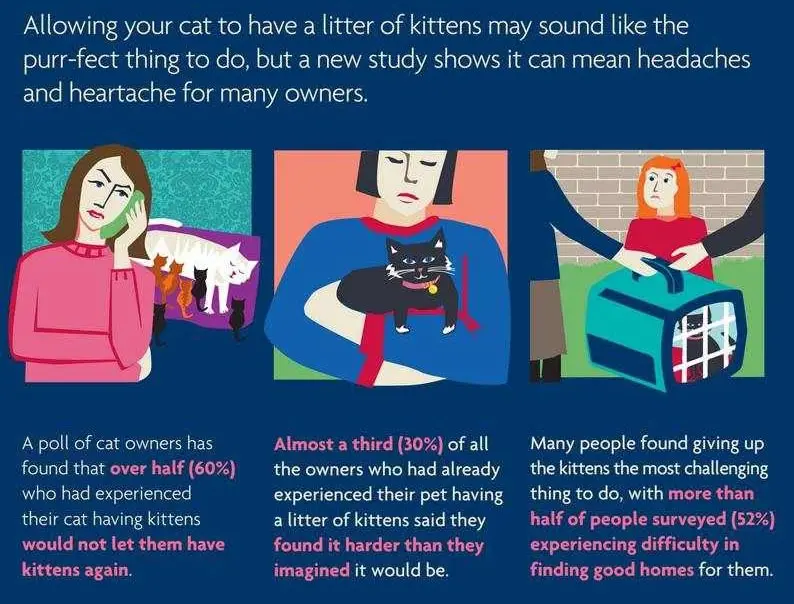
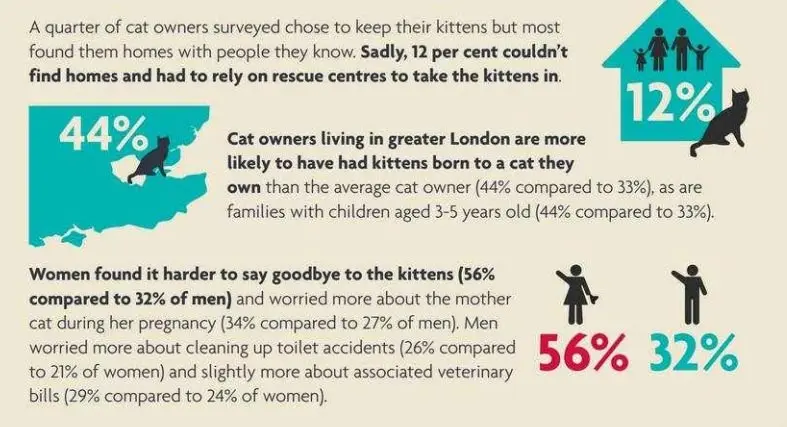
Kittens maybe cute but the reality of letting your cat have a litter is not so rosy as a recent poll of cat owners discovered.
SO WHAT ARE THE BENEFITS OF NEUTERING (SPAYING) FOR YOUR CAT?
Many female cats in season become lost when they are chased by numerous male cats. They often become disorientated and cannot find their way home.
Invariably they become pregnant and have kittens on the streets.
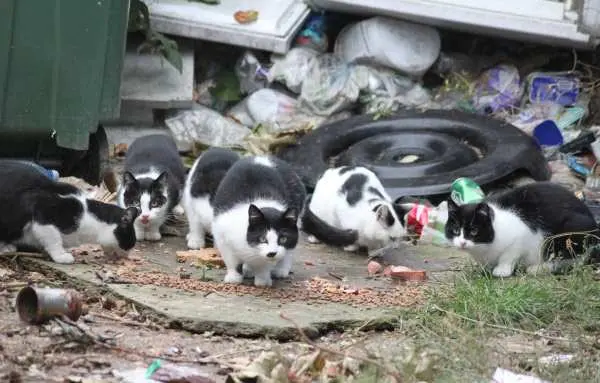
This is how colonies of feral cats are formed. These cats struggle to survive, hungry, often sick or injured.
So many unneutered male cats carry the FIV virus that female cats are at risk if they are bitten during mating. There is no romance between cats when mating. Feline sex can be very violent, particularly when several males are fighting over one female.
FIV and leukaemia virus can be passed to female cats under these circumstances
WHEN SHOULD I NEUTER (SPAY) MY FEMALE CAT?
Female cats should be neutered by 4 months old, but can be neutered at any age afterwards. There is no benefit to your cat in letting her have a litter before she is spayed. If your cat has already had kittens, she should be neutered promptly when her kittens are 6 weeks old or she will become pregnant again. Neutering her will not affect her milk supply.
What about ‘indoor only’ female cats?
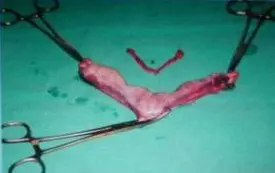
It is important that female cats that are kept permanently indoors are also neutered. This is because they will constantly come into season, which is very frustrating for them, and for you! Unneutered female indoor cats are at risk from various health problems including cystic ovaries and pyometra – a potentially fatal infection of the uterus. Undiagnosed, the uterus fills with pus, and then bursts causing peritonitis and death.
Why do we want to neuter (castrate) your male cat?
Your male cat may not be presenting you with his offspring to find homes for but there are some very good reasons why neutering (castrating him) will protect him from many dangers and give him the best chance of a long and happy life.
To keep your pet from getting lost.
When mature, your unneutered male cat will begin to roam further afield in his search for female cats. As he travels further, he will be at risk when crossing busy roads and from fight injuries acquired during territorial battles with other unneutered male cats. Many male cats roam just a bit too far and cannot find their way home. They then become one of the UK’s 2,500,000 strays that struggle to survive on the streets. A large proportion of cats that are reported to, and taken to, rescue centres are tame unneutered males once owned pets.
To prevent fight injuries
Unneutered male cats are very territorial and aggressive towards other cats. They will be inflicting terrible injuries on other cats, neutered or not! Male cats that have already lost their way home will not have a caring owner to take them to the vet to be treated. Many once loved pets end up in a terrible state with life-threatening injuries.

To prevent infection by FIV (Feline Immunodeficiency Virus – the feline equivalent of HIV)
Fighting unneutered male cats are most at risk of contracting FIV. The virus is transmitted between cats through deep bites incurred during fights. FIV is widespread amongst unneutered male cats and can eventually develop into full-blown disease. There is no vaccine against FIV. Neutered cats are much less aggressive to each other, thus by neutering your male cat, he is much less likely to be involved in fights and therefore less likely to contract FIV.
To prevent spraying
Unneutered male cats spray very strong foul-smelling urine to mark their territory. They may spray in and around your home or your neighbours’ homes. Neutering prevents this.
To be a good neighbour
There is an unnaturally high concentration of cats in UK towns and cities. An unneutered male cat will make himself very unpopular spraying and fighting with other cats in the area. A large proportion of reports to animal charities are from people annoyed by unneutered male cats attacking their cats and spraying inside their homes.
To be responsible pet owners
Rescue centres are full of battered, stray, unneutered male cats, some once loved pets that have roamed too far and become stray. Once neutered they soon make lovely pets again, but the numbers needing homes are so great that many are doomed to join the thousands of unwanted cats that are DESTROYED each day in the UK. If only they had been neutered they probably wouldn’t have become strays in the first place. Male cats should be neutered at four months old, but can be neutered at any age. They are never too old.
The Celia Hammond Animal Trust is a member of Catkind – a coalition of charities all working together to promote cat neutering as a humane solution to the problem of there being too many cats and not enough homes available for them. One of the main objectives of Catkind is the promotion of 4 month neutering to reduce the incidences of accidental litters. Kitten Neutering Database (cat-kind.org.uk)
WHY DO WE WANT TO NEUTER (SPAY) YOUR FEMALE DOG?
Rescue Centres all over the UK are full of unwanted mongrel and pedigree dogs and puppies. All are desperately hoping for new homes. Every day, thousands of unwanted healthy dogs and puppies are destroyed simply because there are not enough homes to go around.
OK, so you agree it is irresponsible to breed from your bitch… but why does she need to be spayed?
- Your bitch will be in season for three weeks each time.
- When in season, she will attract unneutered male dogs.
- A male dog will follow a bitch in season everywhere for a chance to mate. You may have to physically fend him off if he is very persistent.
- Wanting to mate, but being unable to do so, will be very frustrating for your unneutered bitch. It is common for bitches to scale high fences, or even dig their way out to find a male dog with whom to mate.
- Many of the dogs that are brought into dog pounds or rescue centres as strays, are in fact bitches in season.
But I’ve paid a lot of money for my bitch. I want her to mate so that I can sell the puppies…?
- Breeding from a bitch is more expensive and far more time consuming than you could possibly imagine.
- Bitches can give birth to up to 10 or more puppies in each litter.
- Whilst pregnant, your bitch will need 2 or 3 times her usual amount of food.
- When the puppies are being weaned, you will need to feed them 4 times per day. You will also have to toilet train them and clear up after them. Can you afford to replace your sofa and carpet?
If you let your bitch have a litter, and manage to home her puppies, you use homes that the thousands of dogs and puppies in rescue centres could have had ~ THEY MAY END UP BEING DESTROYED.
Please be a responsible owner, arrange for your pet to be neutered (spayed) now. Bitches can be neutered at 4-6 months old or any time after. They are never too old.
WHY DO WE WANT TO NEUTER (CASTRATE) YOUR MALE DOG?
Some people think that routine castration of male dogs is unnecessary. Here are some reasons why we think neutering your dog is the best option:
Population control
There are quite simply too many dogs and puppies and not enough homes. Rescue centres and stray dog pounds all over the UK are full of unwanted mongrel and pedigree dogs and puppies, mainly Staffies and Bull breeds. All are desperately hoping for new homes – most will not get them. Don’t let your dog add to the problem by siring even more puppies that nobody wants.
Neuter to reduce roaming
Your male dog can smell a bitch in heat from a very long distance away, and some dogs will do anything to reach her – including scaling tall fences or digging underneath. These dogs are liable to become lost, get into fights with other dogs or be involved in road traffic accidents as they run across busy roads.
- Roaming male dogs may be rounded up by local authority animal wardens. If their owner is not contactable via an ID microchip or ID tag on their collar and if they remain unclaimed after 7 days are at risk of being destroyed.
- Any dog suspected of being a ‘Pit Bull’ type is likely to be seized by the dog wardens or the police if it is not neutered and microchipped.
Neuter to reduce aggression
Often, male dogs become very sexually frustrated. They may try to mount cushions, or even people’s legs and scent mark by urinating around the house. Some become snappy and dominant around people. Most unneutered male dogs are aggressive toward other male dogs often becoming involved in fights during which they can sustain serious or even life threatening injuries.
Medical advantages of neutering
- Many older unneutered male dogs develop prostate enlargement leading to urinary problems, constipation and the possibility of prostatic cancer. The risk of testicular cancer is also completely removed by neutering.
- Neutering is best done when your dog is about six months old, before he has learned any bad habits but it can be done at any age, they are never too old as long as they are healthy.
- Neutering is a straightforward procedure carried out under anaesthetic.
- Your dog will not become fat or lazy due to being neutered. This will only happen if he is over fed or not given enough exercise.
- Neutering does not take away a dog’s ability to be a guard dog. A neutered dog will be just as protective of his territory and family.
Please be a responsible owner and arrange for your dog to be neutered now.
We are sometimes asked - isn't neutering interfering with nature?
By domesticating cats and dogs, humans have already interfered. By breeding cats and dogs and caring for them, we have helped ensure their breeding success and longer life.
The dog and cat population can either be humanely controlled by neutering or left to nature. Nature is cruel, however, and the population will be controlled by starvation and disease since there are no natural predators of the cat or dog in the UK.
The most likely scenario however would be a situation seen by many holidaymakers in some countries – starving colonies of sick animals which are killed by the authorities to contain numbers – a situation most people in this country would find intolerable.
The choice is ours – yours, actually! Please neuter your pet ~ Be part of the solution, not the problem.

Feline Immunodeficiency Virus (FIV) Info
Although most people have heard of Feline Immunodeficiency Virus (FIV), a virus that can progressively weaken a cat’s immune system, there are many misconceptions about it. This has regrettably led to mass euthanasia of healthy FIV positive cats, or a miserable quality of life due to advice being given to keep cats isolated in virtual quarantine conditions. At CHAT, we are regularly approached for advice from people all over the country who have discovered that their pets or strays they feed are, although healthy, FIV positive and find themselves under considerable pressure to euthanase the cats.
CHAT’s policy on FIV is that routine euthanasia of healthy FIV positive cats is wrong and unnecessary.